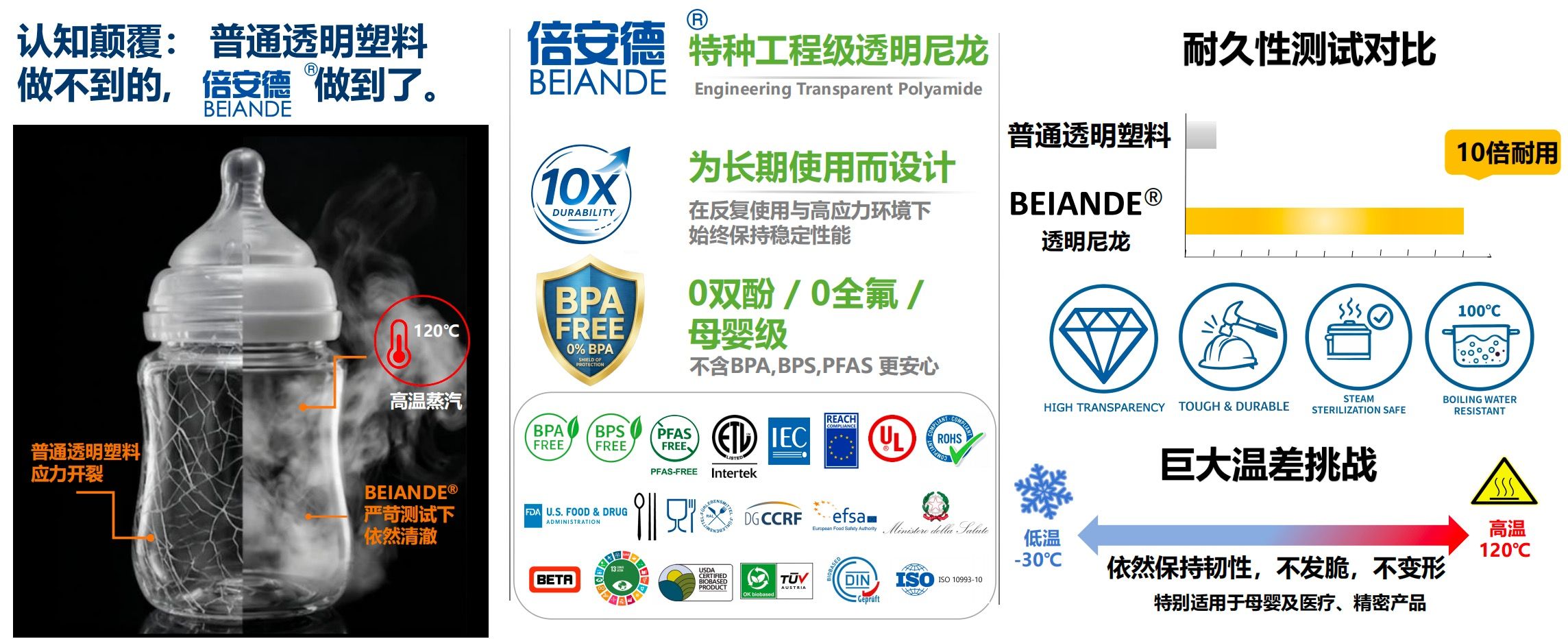
The future is no longer just about being "BPA-Free."
Is "BPA-Free" Really the End of the Story?
Over the past decade, Bisphenol A (BPA) has become one of the most scrutinized chemicals used in food-contact materials. As a result, regulators around the world—particularly in Europe—have significantly restricted or banned its use in many food-contact applications.
But an important question remains:
Are we simply replacing one problematic chemical with another?
Many products marketed as "BPA-free" rely on alternative bisphenols with similar chemical structures. While these substitutes help manufacturers move away from BPA, growing scientific evidence suggests that some may exhibit comparable biological activity.

Studies have raised concerns regarding certain BPA substitutes, including Bisphenol AF (BPAF) and Bisphenol Z (BPZ), which have shown indications of endocrine-related effects in preliminary research.
Although these alternatives are not yet as extensively studied as BPA, regulators are increasingly paying attention to the broader bisphenol family.
This trend reflects a growing regulatory concern known as "regrettable substitution"—replacing a restricted substance with a structurally similar chemical that may pose similar risks.
As a result, authorities across Europe, North America, and Asia-Pacific are expanding their focus beyond BPA itself and moving toward broader restrictions on bisphenol substances as a group.
What does this mean for food-contact materials?
The future is no longer just about being "BPA-Free."
It is increasingly about selecting materials that are designed from the outset to avoid bisphenol chemistry altogether while maintaining performance, durability, and compliance.
For applications such as reusable beverage containers, kettles, coffee machines, kitchen appliances, and transparent food-contact components, material selection is becoming a critical part of long-term regulatory strategy.
At BEIANDE, we believe the industry's direction is clear:
✅ Move beyond single-substance compliance.
✅ Evaluate the full chemical composition of materials.
✅ Prioritize material platforms that are inherently free from bisphenol substances.
This is one reason why increasing attention is being given to high-performance transparent PA12 solutions, which can provide transparency, toughness, and food-contact compliance without relying on bisphenol-based chemistry.
The future of food-contact materials should not simply be about replacing one chemical with another—it should be about designing safer and more sustainable materials from the beginning.